
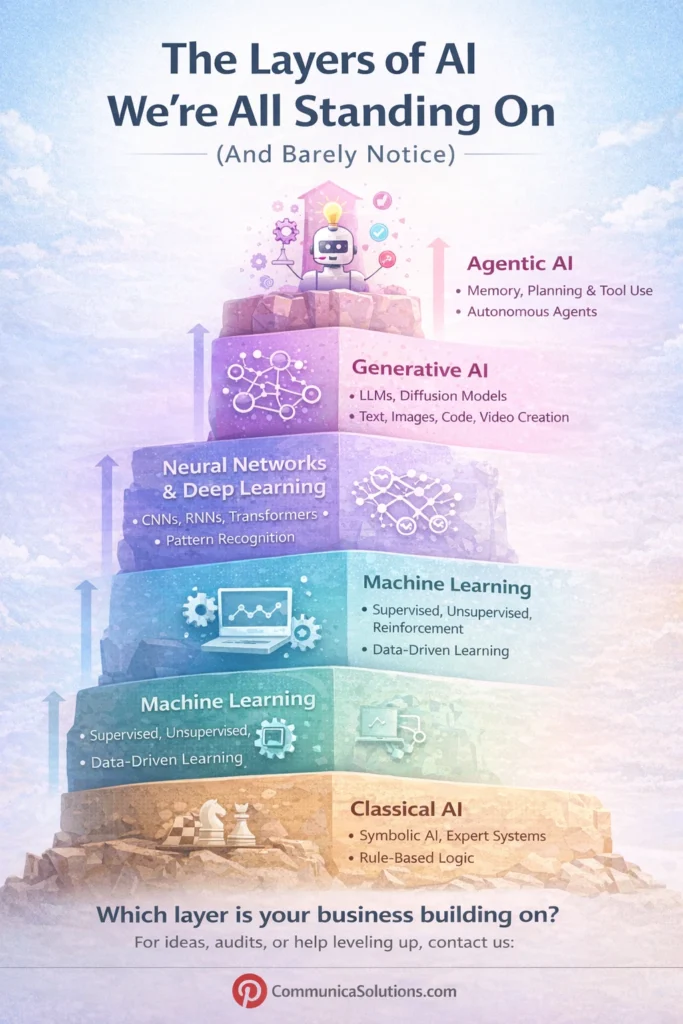
A few weeks ago at CommunicaSolutions, one of our strategists shared this diagram in our team chat: a colorful stack of “Layers of AI” from Classical AI at the bottom all the way up to Agentic AI at the top. Neural networks, deep learning, generative models, autonomous agents each layer building on the one below like geological strata.
We stared at it for a minute. “Wait… this is literally how everything we use works?” We’d been deploying LLMs for content, agents for automation, generative tools for creatives but seeing the full tower? It hit differently. Like realizing the skyscraper you’re living in has 50 floors you never visited.
We’ve spent years helping brands navigate AI from basic chatbots to full agent workflows. This stack reminded us: AI isn’t magic. It’s architecture. Layers built over decades, each unlocking the next. Understanding them changes how you choose tools, build systems, and avoid hype traps.
Let us walk you through it, like we’re reviewing a client stack over coffee.
Read Previous Insight: Google AI Empire No One’s Talking About (But We’re Already Using)
The Big Realization – AI Is a Tower, Not a Tool
We used to think “AI” meant one thing: ChatGPT-style models. Then came diffusion for images, transformers for language, agents for action. But seeing the diagram? It’s clear, everything rests on foundations laid in the 1950s.
Bottom layers handle logic and patterns. Middle layers learn from data. Top layers create and act autonomously. Miss a layer? Your system wobbles.
In marketing, this matters. You can’t jump straight to “agentic” without solid generative and deep learning underneath. We’ve seen brands burn cash on shiny agents that hallucinate because the lower layers weren’t tuned.
Classical AI – The Ancient Foundation
Bottom layer, 1950s-1980s thinking. Symbolic AI, expert systems, rule-based logic, knowledge representation.
No learning. Just if-then rules and logic. Think old-school chess engines or basic decision trees.
Still alive today: Many business rules engines, workflow automation, compliance checks. We use this layer when we need predictable, explainable outcomes.
Machine Learning – Where Learning Begins
Next up statistical learning from data. Supervised, unsupervised, reinforcement learning. Classification, regression, clustering.
This is where AI starts “figuring things out” instead of being hand-coded.
We lean on ML constantly: Customer segmentation, churn prediction, recommendation engines. It’s the bridge from rules to patterns.
Neural Networks & Deep Learning – The Pattern Powerhouse
Here the stack gets thick. Neural nets → RNNs/LSTMs/CNNs → transformers → deep architectures.
Multiple layers learn hierarchical features. Image recognition, speech, language understanding, all born here.
Deep learning is why your phone unlocks with your face and why ads feel creepy-accurate. We use it daily for visual content analysis, sentiment, personalization.
Generative AI – From Understanding to Creation
The layer LLMs, diffusion models, VAEs, multimodal generation.
Not just predicting creating. Text, images, code, music, video.
This is the layer everyone talks about. We generate campaign copy, social visuals, video ideas, even code snippets with it. The leap from analysis to invention.
Agentic AI – Where AI Starts Acting
Top layer memory, planning, tool use, autonomous execution.
Agents don’t just answer; they do. Break goals into steps, use tools, iterate, adapt.
We’re testing this heavily: Agents researching audiences, drafting posts, scheduling, even A/B testing creatives. When it works? Game-changer. When it hallucinates? Back to lower layers for grounding.
Why This Layers of AI Changes How We Work
Understanding layers helps us avoid the “shiny object” trap.
- Want reliable automation? Lean on classical + ML.
- Need creative scale? Generative layer.
- True autonomy? Build strong foundations first, agentic fails without them.
We’ve audited clients who bought “agent” tools without deep learning grounding, results were messy. Fix the base layers → top shines.
Our 5-Layer Playbook for Brands in 2026
- Audit Your Base – Check classical/ML foundations (data quality, rules engines).
- Strengthen Deep Learning – Use transformers for understanding (sentiment, personalization).
- Scale with Generative – Content, visuals, ideation but ground with human oversight.
- Experiment with Agents – Start small: Research agents, content agents.
- Build Incrementally – Never skip layers. Strong tower = lasting results.
Wrapping Up – The Tower Is Still Growing
Reflecting on that diagram, we’re grateful we took the time to zoom out. AI feels chaotic day-to-day, but the layers show order, decades of progress stacked neatly.
The top (agentic) is exciting, but everything rests on what’s below. Build strong foundations, and the future layers work better.
If this resonates, what’s one layer you’re focusing on right now? Reply below, we read every one.
Contact us for personalized ideas and suggestions:
📞 +94 77 761 4719
✉️ info@communicasolutions.com
(And if you’re wondering how these layers fit your business or want a quick audit of your current AI stack, we’re here to help. From Google’s ecosystem to custom agents, we guide brands daily.🚀)
Communica Solutions specializes in local SEO, Google Business Profile optimization, citation management, and comprehensive digital marketing strategies and managing for service-based businesses. Contact us to learn how we can transform your online visibility and drive more qualified leads to your business.